README.md
| 1 | --- |
| 2 | library_name: transformers |
| 3 | license: apache-2.0 |
| 4 | language: |
| 5 | - en |
| 6 | pipeline_tag: object-detection |
| 7 | tags: |
| 8 | - object-detection |
| 9 | - vision |
| 10 | datasets: |
| 11 | - coco |
| 12 | widget: |
| 13 | - src: >- |
| 14 | https://huggingface.co/datasets/mishig/sample_images/resolve/main/savanna.jpg |
| 15 | example_title: Savanna |
| 16 | - src: >- |
| 17 | https://huggingface.co/datasets/mishig/sample_images/resolve/main/football-match.jpg |
| 18 | example_title: Football Match |
| 19 | - src: >- |
| 20 | https://huggingface.co/datasets/mishig/sample_images/resolve/main/airport.jpg |
| 21 | example_title: Airport |
| 22 | --- |
| 23 | |
| 24 | |
| 25 | # Model Card for RT-DETR |
| 26 | |
| 27 | |
| 28 | ## Table of Contents |
| 29 | |
| 30 | 1. [Model Details](#model-details) |
| 31 | 2. [Model Sources](#model-sources) |
| 32 | 3. [How to Get Started with the Model](#how-to-get-started-with-the-model) |
| 33 | 4. [Training Details](#training-details) |
| 34 | 5. [Evaluation](#evaluation) |
| 35 | 6. [Model Architecture and Objective](#model-architecture-and-objective) |
| 36 | 7. [Citation](#citation) |
| 37 | |
| 38 | |
| 39 | ## Model Details |
| 40 | |
| 41 |  |
| 42 | |
| 43 | > The YOLO series has become the most popular framework for real-time object detection due to its reasonable trade-off between speed and accuracy. |
| 44 | However, we observe that the speed and accuracy of YOLOs are negatively affected by the NMS. |
| 45 | Recently, end-to-end Transformer-based detectors (DETRs) have provided an alternative to eliminating NMS. |
| 46 | Nevertheless, the high computational cost limits their practicality and hinders them from fully exploiting the advantage of excluding NMS. |
| 47 | In this paper, we propose the Real-Time DEtection TRansformer (RT-DETR), the first real-time end-to-end object detector to our best knowledge that addresses the above dilemma. |
| 48 | We build RT-DETR in two steps, drawing on the advanced DETR: |
| 49 | first we focus on maintaining accuracy while improving speed, followed by maintaining speed while improving accuracy. |
| 50 | Specifically, we design an efficient hybrid encoder to expeditiously process multi-scale features by decoupling intra-scale interaction and cross-scale fusion to improve speed. |
| 51 | Then, we propose the uncertainty-minimal query selection to provide high-quality initial queries to the decoder, thereby improving accuracy. |
| 52 | In addition, RT-DETR supports flexible speed tuning by adjusting the number of decoder layers to adapt to various scenarios without retraining. |
| 53 | Our RT-DETR-R50 / R101 achieves 53.1% / 54.3% AP on COCO and 108 / 74 FPS on T4 GPU, outperforming previously advanced YOLOs in both speed and accuracy. |
| 54 | We also develop scaled RT-DETRs that outperform the lighter YOLO detectors (S and M models). |
| 55 | Furthermore, RT-DETR-R50 outperforms DINO-R50 by 2.2% AP in accuracy and about 21 times in FPS. |
| 56 | After pre-training with Objects365, RT-DETR-R50 / R101 achieves 55.3% / 56.2% AP. The project page: this [https URL](https://zhao-yian.github.io/RTDETR/). |
| 57 | |
| 58 | |
| 59 | |
| 60 | This is the model card of a 🤗 [transformers](https://huggingface.co/docs/transformers/index) model that has been pushed on the Hub. |
| 61 | |
| 62 | - **Developed by:** Yian Zhao and Sangbum Choi |
| 63 | - **Funded by:** National Key R&D Program of China (No.2022ZD0118201), Natural Science Foundation of China (No.61972217, 32071459, 62176249, 62006133, 62271465), |
| 64 | and the Shenzhen Medical Research Funds in China (No. |
| 65 | B2302037). |
| 66 | - **Shared by:** Sangbum Choi |
| 67 | - **Model type:** [RT-DETR](https://huggingface.co/docs/transformers/main/en/model_doc/rt_detr) |
| 68 | - **License:** Apache-2.0 |
| 69 | |
| 70 | ### Model Sources |
| 71 | |
| 72 | <!-- Provide the basic links for the model. --> |
| 73 | |
| 74 | - **HF Docs:** [RT-DETR](https://huggingface.co/docs/transformers/main/en/model_doc/rt_detr) |
| 75 | - **Repository:** https://github.com/lyuwenyu/RT-DETR |
| 76 | - **Paper:** https://arxiv.org/abs/2304.08069 |
| 77 | - **Demo:** [RT-DETR Tracking](https://huggingface.co/spaces/merve/RT-DETR-tracking-coco) |
| 78 | |
| 79 | ## How to Get Started with the Model |
| 80 | |
| 81 | Use the code below to get started with the model. |
| 82 | |
| 83 | ```python |
| 84 | import torch |
| 85 | import requests |
| 86 | |
| 87 | from PIL import Image |
| 88 | from transformers import RTDetrForObjectDetection, RTDetrImageProcessor |
| 89 | |
| 90 | url = 'http://images.cocodataset.org/val2017/000000039769.jpg' |
| 91 | image = Image.open(requests.get(url, stream=True).raw) |
| 92 | |
| 93 | image_processor = RTDetrImageProcessor.from_pretrained("PekingU/rtdetr_r101vd_coco_o365") |
| 94 | model = RTDetrForObjectDetection.from_pretrained("PekingU/rtdetr_r101vd_coco_o365") |
| 95 | |
| 96 | inputs = image_processor(images=image, return_tensors="pt") |
| 97 | |
| 98 | with torch.no_grad(): |
| 99 | outputs = model(**inputs) |
| 100 | |
| 101 | results = image_processor.post_process_object_detection(outputs, target_sizes=torch.tensor([image.size[::-1]]), threshold=0.3) |
| 102 | |
| 103 | for result in results: |
| 104 | for score, label_id, box in zip(result["scores"], result["labels"], result["boxes"]): |
| 105 | score, label = score.item(), label_id.item() |
| 106 | box = [round(i, 2) for i in box.tolist()] |
| 107 | print(f"{model.config.id2label[label]}: {score:.2f} {box}") |
| 108 | ``` |
| 109 | This should output |
| 110 | ``` |
| 111 | sofa: 0.97 [0.14, 0.38, 640.13, 476.21] |
| 112 | cat: 0.96 [343.38, 24.28, 640.14, 371.5] |
| 113 | cat: 0.96 [13.23, 54.18, 318.98, 472.22] |
| 114 | remote: 0.95 [40.11, 73.44, 175.96, 118.48] |
| 115 | remote: 0.92 [333.73, 76.58, 369.97, 186.99] |
| 116 | ``` |
| 117 | |
| 118 | ## Training Details |
| 119 | |
| 120 | ### Training Data |
| 121 | |
| 122 | <!-- This should link to a Dataset Card, perhaps with a short stub of information on what the training data is all about as well as documentation related to data pre-processing or additional filtering. --> |
| 123 | |
| 124 | The RTDETR model was trained on [COCO 2017 object detection](https://cocodataset.org/#download), a dataset consisting of 118k/5k annotated images for training/validation respectively. |
| 125 | |
| 126 | ### Training Procedure |
| 127 | |
| 128 | <!-- This relates heavily to the Technical Specifications. Content here should link to that section when it is relevant to the training procedure. --> |
| 129 | |
| 130 | We conduct experiments on COCO and Objects365 datasets, where RT-DETR is trained on COCO train2017 and validated on COCO val2017 dataset. |
| 131 | We report the standard COCO metrics, including AP (averaged over uniformly sampled IoU thresholds ranging from 0.50-0.95 with a step size of 0.05), |
| 132 | AP50, AP75, as well as AP at different scales: APS, APM, APL. |
| 133 | |
| 134 | ### Preprocessing |
| 135 | |
| 136 | Images are resized to 640x640 pixels and rescaled with `image_mean=[0.485, 0.456, 0.406]` and `image_std=[0.229, 0.224, 0.225]`. |
| 137 | |
| 138 | ### Training Hyperparameters |
| 139 | |
| 140 | - **Training regime:** <!--fp32, fp16 mixed precision, bf16 mixed precision, bf16 non-mixed precision, fp16 non-mixed precision, fp8 mixed precision --> |
| 141 | |
| 142 |  |
| 143 | |
| 144 | |
| 145 | ## Evaluation |
| 146 | |
| 147 | |
| 148 | | Model | #Epochs | #Params (M) | GFLOPs | FPS_bs=1 | AP (val) | AP50 (val) | AP75 (val) | AP-s (val) | AP-m (val) | AP-l (val) | |
| 149 | |----------------------------|---------|-------------|--------|----------|--------|-----------|-----------|----------|----------|----------| |
| 150 | | RT-DETR-R18 | 72 | 20 | 60.7 | 217 | 46.5 | 63.8 | 50.4 | 28.4 | 49.8 | 63.0 | |
| 151 | | RT-DETR-R34 | 72 | 31 | 91.0 | 172 | 48.5 | 66.2 | 52.3 | 30.2 | 51.9 | 66.2 | |
| 152 | | RT-DETR R50 | 72 | 42 | 136 | 108 | 53.1 | 71.3 | 57.7 | 34.8 | 58.0 | 70.0 | |
| 153 | | RT-DETR R101| 72 | 76 | 259 | 74 | 54.3 | 72.7 | 58.6 | 36.0 | 58.8 | 72.1 | |
| 154 | | RT-DETR-R18 (Objects 365 pretrained) | 60 | 20 | 61 | 217 | 49.2 | 66.6 | 53.5 | 33.2 | 52.3 | 64.8 | |
| 155 | | RT-DETR-R50 (Objects 365 pretrained) | 24 | 42 | 136 | 108 | 55.3 | 73.4 | 60.1 | 37.9 | 59.9 | 71.8 | |
| 156 | | RT-DETR-R101 (Objects 365 pretrained) | 24 | 76 | 259 | 74 | 56.2 | 74.6 | 61.3 | 38.3 | 60.5 | 73.5 | |
| 157 | |
| 158 | |
| 159 | |
| 160 | ### Model Architecture and Objective |
| 161 | |
| 162 | 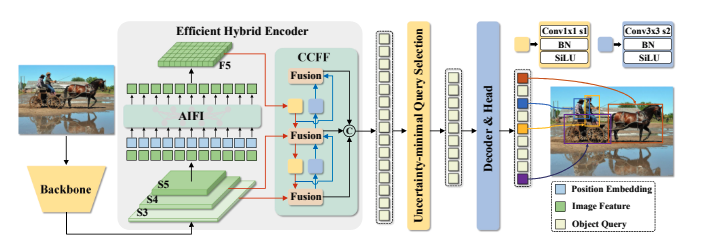 |
| 163 | |
| 164 | Overview of RT-DETR. We feed the features from the last three stages of the backbone into the encoder. The efficient hybrid |
| 165 | encoder transforms multi-scale features into a sequence of image features through the Attention-based Intra-scale Feature Interaction (AIFI) |
| 166 | and the CNN-based Cross-scale Feature Fusion (CCFF). Then, the uncertainty-minimal query selection selects a fixed number of encoder |
| 167 | features to serve as initial object queries for the decoder. Finally, the decoder with auxiliary prediction heads iteratively optimizes object |
| 168 | queries to generate categories and boxes. |
| 169 | |
| 170 | |
| 171 | ## Citation |
| 172 | |
| 173 | <!-- If there is a paper or blog post introducing the model, the APA and Bibtex information for that should go in this section. --> |
| 174 | |
| 175 | **BibTeX:** |
| 176 | |
| 177 | ```bibtex |
| 178 | @misc{lv2023detrs, |
| 179 | title={DETRs Beat YOLOs on Real-time Object Detection}, |
| 180 | author={Yian Zhao and Wenyu Lv and Shangliang Xu and Jinman Wei and Guanzhong Wang and Qingqing Dang and Yi Liu and Jie Chen}, |
| 181 | year={2023}, |
| 182 | eprint={2304.08069}, |
| 183 | archivePrefix={arXiv}, |
| 184 | primaryClass={cs.CV} |
| 185 | } |
| 186 | ``` |
| 187 | |
| 188 | ## Model Card Authors |
| 189 | |
| 190 | [Sangbum Choi](https://huggingface.co/danelcsb) |
| 191 | [Pavel Iakubovskii](https://huggingface.co/qubvel-hf) |
| 192 | |
| 193 | |